
 EN
What Are the Benefits of Gasoline Lawn Mowers for Large Outdoor Areas?
When a lawn is large, uneven, or allowed to grow quickly between cuts, a gasoline lawn mower can be a practical tool rather than simply a familiar one. The advantage is not that every petrol-powered machine is automatically better. It is that a gasoline lawn mower can combine sustained power, quick refuelling, and a broad choice of deck and drive configurations when a site asks more of the operator than a short weekly trim.
As garden-machinery specialists see repeatedly, the useful question is not just, “How big is the engine?” It is whether the machine matches the grass condition, terrain, route, and time available. For a large outdoor area, that distinction affects cut quality, operator fatigue, and how often a mowing schedule gets delayed.
1. Continuous working time suits larger mowing routes
The clearest benefit of a gasoline lawn mower is that it can keep working as long as fuel and routine checks are available. A battery mower may be an excellent fit for a compact, tidy lawn, but runtime planning becomes more important when the route includes broad open sections, perimeter edges, or several separated plots. With a gasoline lawn mower, refuelling is usually faster than pausing for a battery charge, so the operator can return to the route without reorganising the day around charging windows.
That does not eliminate downtime. Fuel, oil level, air-filter condition, and blade condition still need attention. But for maintenance teams and property owners who cut sizeable grounds in one session, predictable refuelling can make the workflow easier to manage.
2. Power helps when grass is dense or the cut has been delayed
Large grounds are not necessarily cut at ideal intervals. Weather, access, or labour availability can leave the grass longer, thicker, or slightly tougher than planned. In those conditions, a well-matched gasoline lawn mower can provide the torque needed to keep the blade moving through heavier growth. The important qualifier is “well-matched”: engine displacement alone does not guarantee a better finish. Blade sharpness, deck airflow, ground speed, and how much height is removed in one pass all matter.
For example, a self propelled mower lets the operator slow down without also having to push hard against the machine. That can help maintain a more even pace in dense grass. If clippings begin to clump or the deck starts to clog, reducing ground speed and taking a smaller cut is generally more sensible than forcing any gasoline lawn mower through the area.
3. Self-propelled drive reduces fatigue on long passes
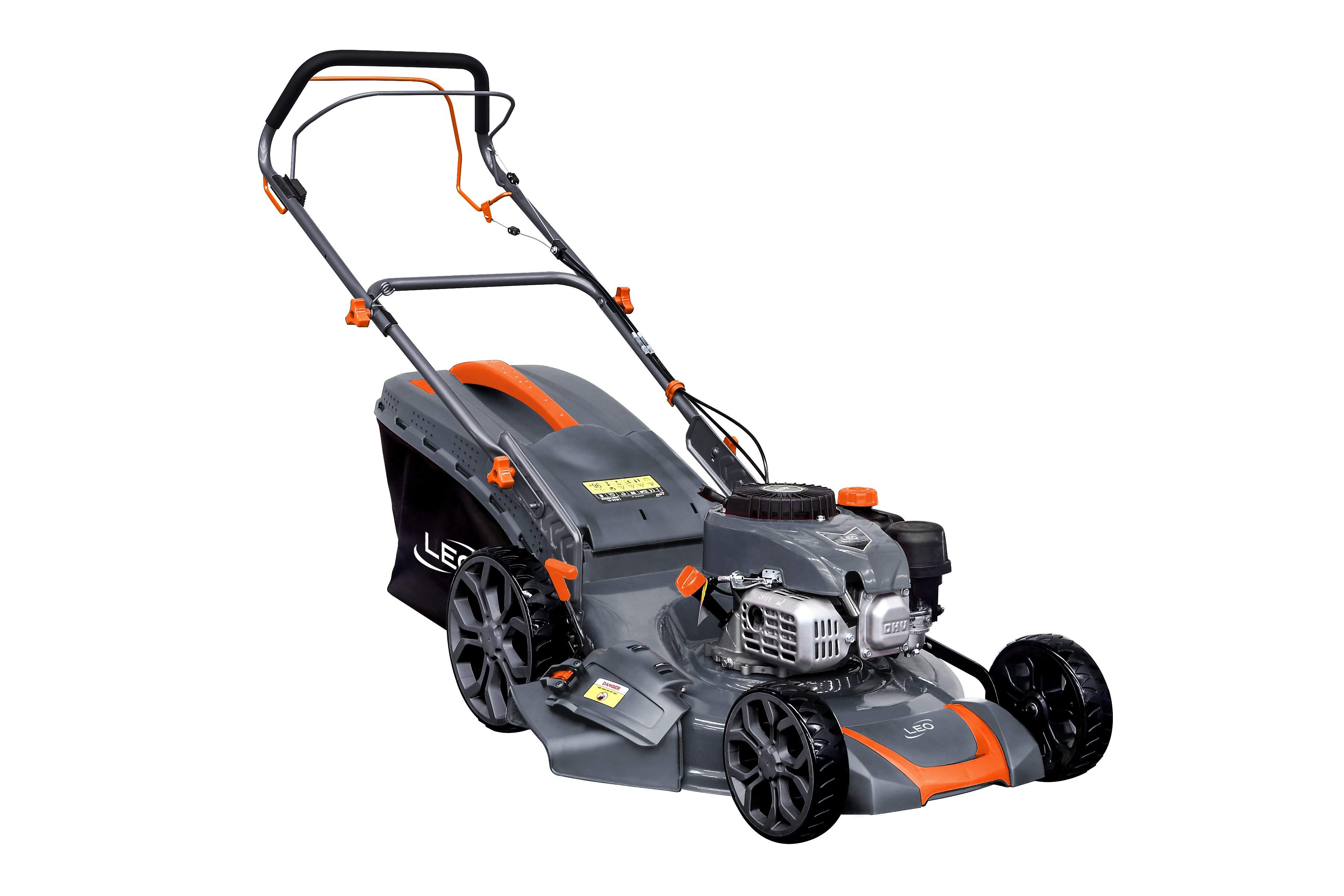
On a large lawn, walking distance is a cost in itself. A gasoline lawn mower with self-propelled drive can take much of the pushing effort out of repeated passes, especially over variable terrain. This is where a self propelled mower for large lawns earns attention: the benefit is not speed for its own sake, but more controlled movement when the ground is rough, the grass is resisting the deck, or the operator has another section still to cover.
There is a trade-off. A driven mower is typically heavier and has more components to maintain than a simple push machine. For a small, flat garden, that complexity may not repay itself. On a bigger site, however, less pushing can help an operator keep a steadier working rhythm and avoid rushing the final part of the job.
4. Cutting-width choices can shorten open-area work
A larger cutting deck can reduce the number of passes needed across an open lawn. That is why a gasoline lawn mower is often considered when an area is too large for a narrow domestic machine but does not necessarily justify a riding mower. Common category configurations include walk-behind decks around 21 inches, while wider models can suit more open layouts.
A wider deck is not necessarily faster. A wide deck can lose its advantage around trees, borders, narrow gates, and curved beds because each turn takes space. Before choosing a gasoline lawn mower, walk the actual route. If most of the time is spent turning and trimming around obstacles, manoeuvrability may matter more than maximum deck width.
5. Deck functions make one machine more adaptable
Many gasoline walk-behind models offer bagging, side discharge, or mulching arrangements. A mulching mower can be useful when the lawn is maintained frequently and the clippings are short enough to be returned evenly to the turf. Bagging can be more appropriate when presentation matters or grass has become too long for neat mulching. Side discharge may be the practical fallback for heavier growth, subject to site safety and local operating requirements.
The value of a gasoline lawn mower here is adaptability, not a promise that one deck mode fits every condition. Wet or clumped grass can block a mulch deck, so operators should adjust height, pace, or collection method rather than expect a single setting to solve every job.
6. A practical middle ground before moving to ride-on equipment
Commercial walk behind mowers can fill the gap between light domestic equipment and a ride-on mower. They retain the closer control of walking behind the machine while offering stronger drive systems and work-oriented layouts. A gasoline lawn mower in this class may make sense for large but intricate sites where trees, slopes, narrow access points, or landscaped edges make a ride-on format less convenient.
If the property is mostly broad, obstacle-free turf and mowing takes many hours each week, a ride-on machine may be the better next comparison. Conversely, a walk-behind gasoline lawn mower is often easier to position precisely around features. The threshold is not a fixed acreage number; it depends on the layout, not just the map.
What should you weigh before choosing a gasoline mower?
The benefits of a gasoline lawn mower come with responsibilities. Fuel storage, engine servicing, exhaust, and operating noise deserve real weight in the decision. Follow the manufacturer’s instructions for fuel and slope limits, mow in dry conditions where possible, and keep people clear of the discharge area. For steep slopes, ditches, and unstable ground, do not assume more engine power makes the situation safer.
Also consider local rules and the working environment. Battery equipment can be a stronger choice where noise, indoor storage, emissions, or short routine cuts are the priority. A gasoline lawn mower is most compelling when the site needs sustained work capacity, refuelling flexibility, and a configuration that can cope with longer or more variable grass.
Conclusion
For large outdoor areas, a gasoline lawn mower can offer long uninterrupted sessions, useful cutting power, self-propelled assistance, and deck options that adapt to different grass conditions. Select the drive system and deck width around the actual route, maintain the machine carefully, and keep safety and environmental constraints in the decision. That approach makes a gasoline lawn mower a purposeful fit for demanding grounds rather than a default choice.
 Hot News