
 EN
What Are the Differences Between Residential and Commercial Lawn Mowers?
At first glance, a lawn mower is simply a machine that cuts turf. In practice, the right lawn mower is defined by how long it must work, what kind of ground it crosses, how quickly it must move to the next property, and who will maintain it. A homeowner usually needs tidy results on a familiar lawn. A landscaping crew needs repeatable output across many lawns, often with little room for downtime. That application difference matters more than paint color or a single headline specification.
From a landscaping contractor’s viewpoint, the useful question is not “Which lawn mower has the largest number on the brochure?” It is “Which machine fits the workday?” A residential model can be a sensible, efficient choice for routine home use. A commercial mower earns its higher-duty design when the job involves recurring hours, varied sites, operator changes, and a need for fast service.
Residential and commercial use start with different workloads
Residential equipment is generally designed around periodic use on one or a few properties. The owner knows the lawn layout, can pause for charging or emptying, and usually stores the machine after each session. Comfort, storage size, starting simplicity, noise preferences, and budget often carry significant weight in this decision.
A commercial mower is selected for a different rhythm. Crews may cut several properties in one day, load and unload equipment repeatedly, and work through denser turf or changing weather. That does not mean every professional needs the largest machine. It means the lawn mower should be evaluated for duty cycle: the expected hours of operation, the pace of the route, and how disruptive an unplanned repair would be.
For buyers serving both homeowner and contractor channels, this application difference is the anchor for a clearer product conversation. Rather than calling one lawn mower “better,” match the machine to the acreage, obstacles, turf conditions, transport plan, and maintenance capacity.
 Residential and commercial mower choices begin with the expected workload.
Key differences at a glance
| Decision area | Residential lawn mower | Commercial mower |
|---|---|---|
| Typical use | Periodic care of familiar home lawns | Frequent work across multiple landscaping sites |
| Design priority | Convenience, storage, and approachable controls | Throughput, durability, and service access |
| Deck and chassis | Matched to lighter, intermittent use | Built for repeated cycles and demanding routes |
| Operator workflow | Usually one owner with a known property | Often several operators and varied properties |
| Maintenance planning | Seasonal or owner-managed routine | Scheduled checks integrated into the workday |
| Purchase lens | Initial cost and home-lawn fit | Total operating cost and lost-time exposure |
Deck size is about access as well as speed
A wider deck on a lawn mower can cover more open turf in a pass, but it can also be harder to maneuver around beds, entry points, trees, and narrow paths. For a compact yard with landscaping features, a residential lawn mower with a manageable cutting width may finish the job more smoothly than a larger unit that needs repeated repositioning.
On broad, open properties, a commercial mower may reduce the time spent crossing the same area. Yet width alone does not establish suitability. A landscaping route can include small fenced yards in the morning and open turfs in the afternoon. Buyers should map access points and turning space before treating deck width as a shortcut to productivity.
Ask a practical question: can the lawn mower enter every area it is expected to maintain without adding trimming, backing, or transport delays? The answer often reveals whether a single machine or task-specific equipment makes more sense.
Power, drive systems, and cut quality
Residential equipment often emphasizes straightforward operation. Depending on the format, it may be push, self-propelled, battery-powered, or ride-on. A homeowner can prioritize easy handling and a power source that fits the lawn size and storage arrangement. For a lawn mower used once a week on maintained turf, that can be a well-matched approach.
A commercial mower is usually considered where repeated operation, heavier growth, and route timing place more demand on the powertrain, drive system, deck, and controls. The relevant comparison is not engine size by itself. Terrain, turf moisture, operator technique, blade condition, and deck cleanliness all influence how a lawn mower performs. Higher output on paper does not automatically produce a cleaner cut on every lawn.
Drive choice deserves equal attention. Self-propelled walk-behind units can suit uneven or constrained sites. Ride-on and zero-turn formats can suit larger, more open layouts, but traction and slope limits must be checked against the manufacturer’s instructions. Do not assume that a faster-looking lawn mower is appropriate for a slope or wet surface.
Operator comfort becomes a business issue with longer shifts
On a residential lawn mower, comfort helps make yard care less tiring. On a commercial mower, it can affect consistency through a full route. Control placement, vibration, seat support, visibility, and steering effort can shape how an operator works over repeated sessions. If several crew members will use the machine, accessible controls and clear adjustment procedures are worth reviewing before purchase.
There is also a human side to the application difference. A machine that is easy for one owner to use on a Saturday may feel very different after several properties. That is why a landscaping buyer should assess the actual operator position, turns, loading routine, and expected session length instead of deciding only from a specification sheet.
Maintenance and serviceability separate the categories
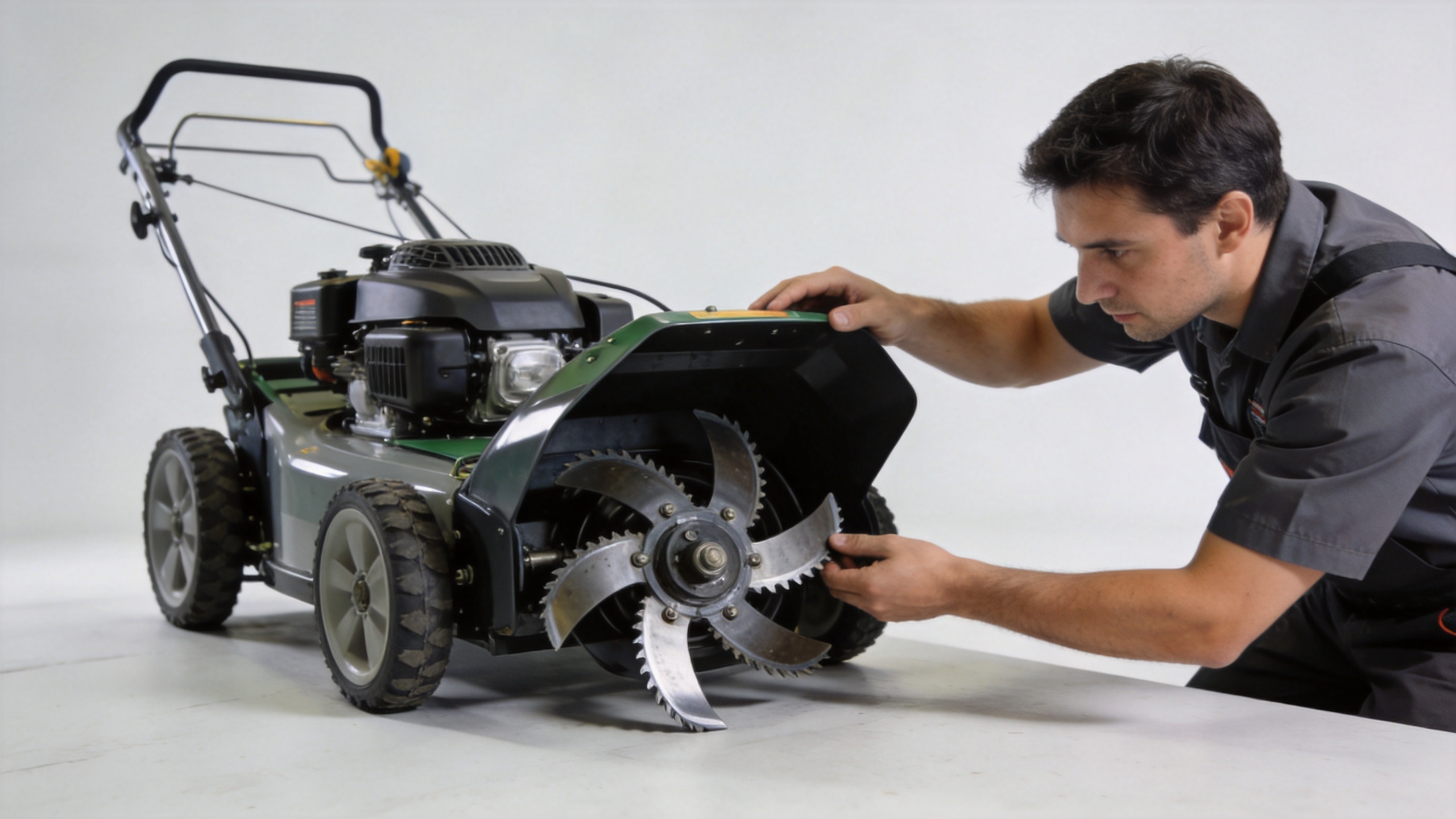
Every lawn mower needs routine attention: follow the operator manual, inspect guards and fasteners, keep the cutting system in sound condition, and address service intervals appropriate to the model. For a homeowner, this may be a seasonal checklist plus care before storage. For a commercial mower, inspection and cleaning frequently become part of the daily operating routine because a missed workday can affect a customer schedule.
Service access is therefore important. Consider how easily the crew can inspect the deck, blades, belts, filters, battery connections, or fluids specified for the particular machine. Parts availability, dealer support, and maintenance documentation also matter in a commercial setting. A lower purchase price can lose its appeal if the lawn mower is difficult to service when the route is full.
How to choose the right category
- List the real workload. Record property count, typical mowing frequency, open versus tight areas, and likely seasonal growth.
- Measure access. Check access openings, paths, storage space, trailer capacity, and turning zones before choosing a lawn mower format.
- Match the power source to the work window. Account for charging, refueling, storage, and the time available between jobs.
- Plan maintenance before purchase. Decide who will inspect, clean, sharpen, and service the equipment and where that work will happen.
- Compare total operating fit. Include labor time, transport, routine service, and downtime exposure—not only the initial invoice.
When each option makes sense
A residential lawn mower usually makes sense when the work is limited to home lawns, usage is intermittent, access is tight, and the owner values simple storage and controls. A commercial mower is more appropriate when landscaping work is recurring, time-sensitive, spread across several sites, or dependent on equipment that can be inspected and serviced within an organized workflow.
The boundary is not fixed. A large private property may justify a more robust lawn mower, while a small landscaping operator may begin with carefully chosen residential equipment. The sound decision comes from matching the mower to the application difference today while allowing for the route, crew, and landscaping workload that are realistically expected next.
Final takeaway
Residential and commercial lawn mowers solve related but different problems. Residential equipment focuses on manageable ownership and routine lawn care. A commercial mower focuses on sustained output, serviceability, and predictable work across changing sites. Start with the job rather than the label, and the right lawn mower category becomes much easier to identify.
 Hot News