
 EN
What Safety Features Should Modern Ride On Mowers Include?
A modern ride on mower should do more than cut a large lawn quickly. It should help prevent predictable mistakes before they become injuries: starting with a blade engaged, leaving the seat while the deck is running, losing control on uneven ground, or operating too close to an edge. As garden-machinery technical consultants, we start with the site rather than a glossy feature list. A safe ride on mower is one whose controls, braking, stability, and operator protection suit the terrain and the people who will use it.
This matters for homeowners, grounds teams, dealers, and buyers specifying equipment for others. A sensible safety system cannot replace training or judgment, but it can create layers of protection when attention slips. The practical question is: which features should be non-negotiable, and which need to be matched to the job?
Start with an integrated safety system
The most useful safety system is integrated into the ride on mower, not added as an afterthought. Look for a clear operating manual, legible warning labels, guarded moving parts, and controls that are easy to identify from the seat. The operator should be able to reach the brake, steering controls, throttle, cutting-height adjustment, and blade control without stretching or shifting position.
Modern equipment standards address this whole-machine approach. For example, EN ISO 5395-3 covers safety topics for combustion-engine ride-on lawnmowers including controls, brakes, guards, stability, rollover protective structures, and operator provisions. That is a useful purchasing reference, not proof that any individual machine meets a particular certification. Ask the supplier for the applicable documentation for the market where the machine will be used.
1. Operator-presence and seat-interlock controls
Operator-presence controls are foundational ride on mower safeguards. A seat switch can detect whether the operator remains in the normal seating position. When the operator gets off or rises from the seat, the machine should respond in a controlled way according to its design, commonly by stopping the blades and preventing unsafe continued operation.
OSHA safety guidance specifically calls for an operator-presence control that shuts off blades when an operator dismounts or rises, along with interlocks that prevent the engine from starting while the machine is in gear or the blade is engaged. When assessing a ride on mower, ask to see these functions demonstrated. Do not accept a vague assurance that a switch exists; check that the behavior is understandable and that replacement or testing procedures are available.
Good operator protection also depends on sensible restart logic. The operator should need to be seated, with drive and blade controls in a safe state, before starting. This reduces the chance of an unexpected movement or rotating blade during a rushed restart.
2. Blade-stop, PTO, and start interlocks
A ride on mower needs a positive way to disengage the cutting deck. Whether the machine uses a mechanical or electric PTO control, the control should be plainly marked, deliberate to operate, and easy to verify. The deck should not start merely because the engine starts. Equally, the machine should not be able to start with the PTO engaged or with a drive control set for movement.
These interlocks are an important part of a practical safety system. They reduce exposure to a blade hazard while the operator mounts, adjusts the machine, clears the work area, or prepares to transport it. A buyer should also check whether guards around belts, pulleys, and discharge areas are robust and can be refitted correctly after routine maintenance.
3. Reliable brakes, parking brake, and speed control
Stopping ability deserves the same attention as engine power. A capable ride on mower should have responsive service brakes, a parking brake that holds the machine securely, and a speed-control arrangement that allows gradual changes. Test these functions only in a clear, level demonstration area and follow the manufacturer’s instructions.
For a ride on mower used around trees, paths, gates, or landscaped features, smooth low-speed control can be as important as top speed. The machine needs predictable steering and enough clearance around pedals and levers to prevent accidental activation. A thoughtful mower design also keeps the operator’s feet within protected footrests rather than near moving or hot components.
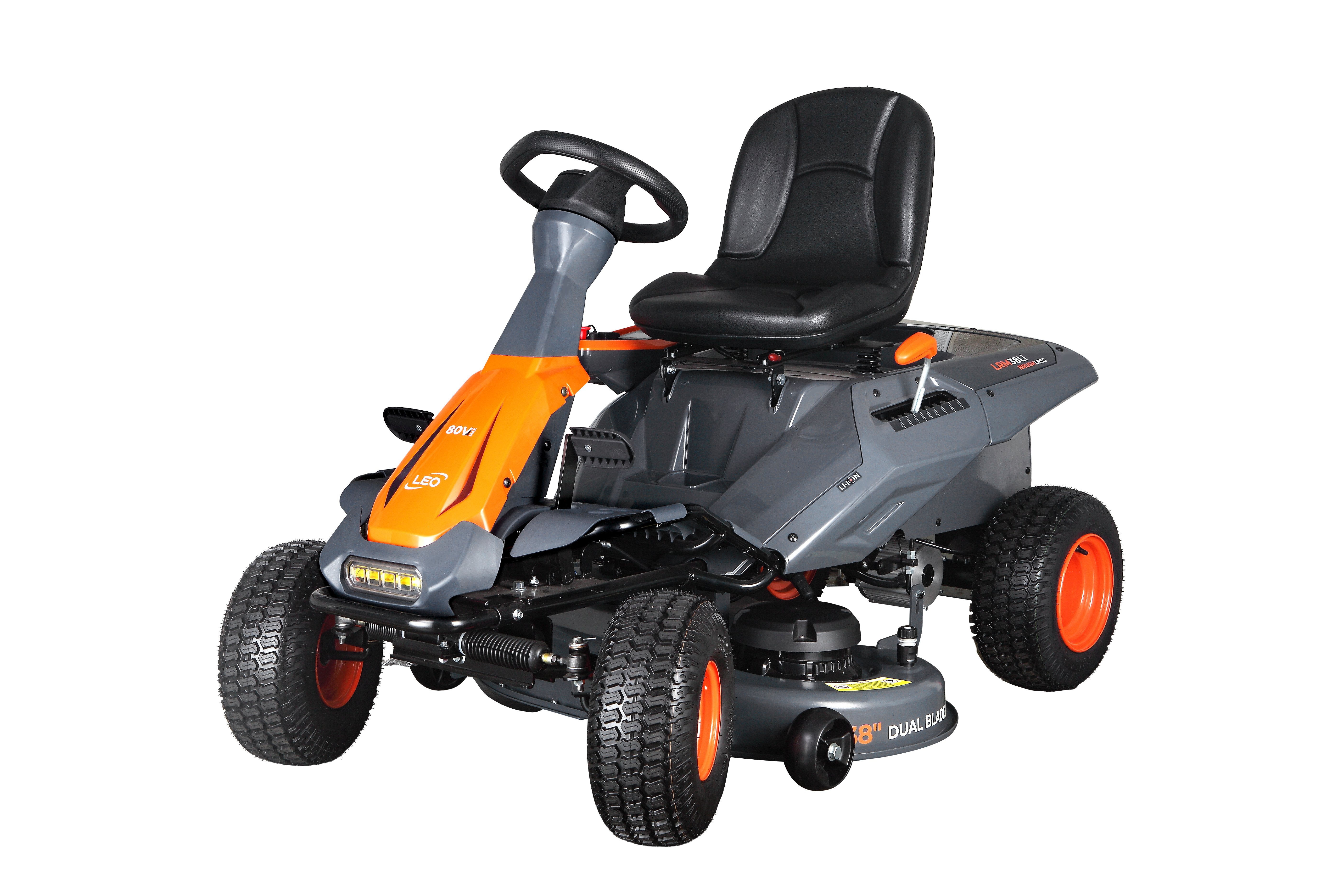 Operator protection features should be evaluated as part of the complete mowing system.
4. Slope stability and rollover protection
Not every ride on mower is appropriate for sloped ground. Stability is affected by the gradient, damp grass, surface changes, turning, load, tyre condition, cutting-deck position, and the machine’s center of gravity. A wide deck or powerful engine does not make a machine safe on a hill. If the site has banks, drop-offs, drainage ditches, or uneven ground, assess whether a walk-behind mower or another method is safer.
Where a ride on mower is designed and equipped for it, a rollover protective structure (ROPS) can provide important operator protection. Safety guidance pairs an upright ROPS with a seat belt; using a belt while the ROPS is lowered is not the same protective arrangement. Treat this as a matched system and follow the specific manufacturer instructions. Do not assume that a roll bar can be retrofitted or used in every situation without approved guidance.
A careful mower design will also provide stable seating, secure handholds, and clear guidance on turning, towing, and slope limits. No feature removes the need to avoid sudden turns, wet slopes, edges, or unsuitable terrain.
5. Guards, shielding, and safe discharge control
On a ride on mower, guards are practical barriers between people and energy. Check the condition and fit of belt covers, pulley guards, exhaust heat shields, deck shields, and the discharge chute or collection system. Guards should be durable enough for normal use and designed so ordinary servicing does not encourage operators to leave them off.
Before mowing, clear stones, wire, toys, and other debris from the work area. The discharge direction matters: it should not be aimed toward people, roads, windows, or vehicles. A dependable safety system combines guarding with an operating routine that keeps bystanders, children, and pets out of the mowing zone.
6. Visibility, lighting, and warning information
A ride on mower is easier to use safely when the operator can see the front path, deck edges, reversing area, and nearby obstacles. Seat position, steering-column layout, bonnet height, mirrors where fitted, and clean lenses all affect visibility. Lights may help when equipment is moved at low light, but they do not make mowing in poor visibility automatically safe.
Look for readable indicators and warnings for parking-brake status, blade engagement, fuel or battery condition, and faults where applicable. Well-designed warnings support the operator’s decisions; they should not be the only line of defense. This is where equipment standards and a coherent mower design work together.
7. Maintenance access is a safety feature
Safety does not end at purchase. A ride on mower with awkward service access is more likely to be maintained poorly. Buyers should check the instructions for blade inspection, belt checks, battery or fuel-system work, tyre pressure, brake adjustment, and safety-switch testing. Replacement guards, labels, and parts should be obtainable through a credible service channel.
Build a pre-use routine around the ride on mower: inspect guards, tyres, controls, seat switch, brake, and the area to be cut. Stop the engine, remove the key, and follow the manufacturer’s isolation steps before clearing a blockage or working near the deck. Regular inspection keeps the intended operator protection functioning rather than merely present on the specification sheet.
A buyer’s safety checklist
- Confirm that the ride on mower has demonstrable seat, PTO, and neutral/drive interlocks.
- Check blade-stop behavior, brake response, parking-brake holding ability, and guarded moving parts.
- Match the ride on mower to the actual terrain; do not assume it is suitable for slopes.
- Where relevant, verify approved ROPS and seat-belt guidance as one complete safety arrangement.
- Review the manual, service access, replacement-part support, and applicable equipment standards documentation.
- Train every operator in the site rules, pre-use inspection, bystander control, and safe shutdown.
Choose the features that fit the work
The right ride on mower balances productivity with predictable, layered safeguards. Prioritize an integrated safety system, tested interlocks, controlled blade operation, reliable brakes, sound guarding, and terrain-appropriate stability. Then make sure those features are supported by training and maintenance. It depends on the site, of course, but that disciplined approach gives buyers a far better basis for comparing modern machines than engine size or cutting width alone.

 Hot News