
 EN
Why Are Battery Operated Ride On Mowers Suitable for Modern Landscaping?
Modern landscaping crews are asked to maintain more sites with less disruption: residential developments, schools, hospitality grounds, parks, and light municipal areas. A battery operated ride on mower can fit that work well because it combines seated productivity with a quieter, exhaust-free-at-point-of-use powertrain. That does not make every electric machine the right answer. The useful question is whether the machine, batteries, charging plan, terrain, and service support match the route it will actually run.
For an operator who works around people, buildings, and scheduled site access, the strongest benefit is often operational control rather than a slogan. A well-matched battery operated ride on mower can help crews start promptly, work with fewer fuel-handling tasks, and keep the working environment more comfortable for nearby staff and visitors. Those advantages matter when landscaping is part of a broader property experience.
Quieter work supports more flexible site schedules
Noise is a practical planning issue in commercial landscaping. Petrol equipment can be effective, but its engine noise may narrow the hours when teams can work near offices, residences, clinics, or public spaces. Electric machinery still makes sound from blades, tyres, airflow, and the cutting deck; it is not silent. Yet removing the combustion engine changes the sound profile and can make conversations, instructions, and customer-facing work easier to manage.
That distinction matters for a landscaping manager. A battery operated ride on mower may be suitable when the goal is to reduce disruption during routine maintenance, not when the expectation is that every mowing task becomes noiseless. Before buying, ask for the declared sound-power information for the actual model and assess the noise of the full cutting system, not just the motor.
It reduces fuel-related routine work
A battery operated ride on mower removes on-site petrol refuelling, engine-oil changes, spark plugs, and many of the checks associated with small combustion engines. For crews managing several properties, that can simplify daily preparation and reduce the chance that a job is delayed by stale fuel, a cold-start problem, or a missed engine service interval. This is one reason an eco friendly mower can be appealing to facilities teams that are trying to improve site operations as well as their environmental communication.
The sustainability case still needs care. Battery manufacture, electricity source, transport, and end-of-life collection all matter. Treat the machine as an eco friendly mower only after considering the whole operating system: sensible charging, repairable components where available, responsible battery handling, and a realistic replacement plan. It is better to make a measured claim than to imply that every electric option has the same lifecycle impact.
Electric drive can suit repeatable commercial routes
For commercial landscaping, predictability is a major advantage. A crew that cuts similar areas on a scheduled route can map the typical mowing time, grass conditions, travel distance, and charging window. That makes it possible to assign a battery operated ride on mower to sites that fall within its demonstrated coverage rather than hoping a single charge will stretch through an unknown workload.
EPA inventory material has historically illustrated the scale difference between commercial and residential lawn-mower activity, listing substantially higher annual use for commercial equipment. The point is not to treat one old inventory figure as a performance benchmark. It is to recognise that commercial landscaping places a different demand on uptime, charging access, and spare-machine planning. A fleet manager should request the manufacturer’s area-per-charge guidance under conditions similar to the intended route, then allow headroom for wet grass, slopes, bagging, transport between sites, and battery ageing.
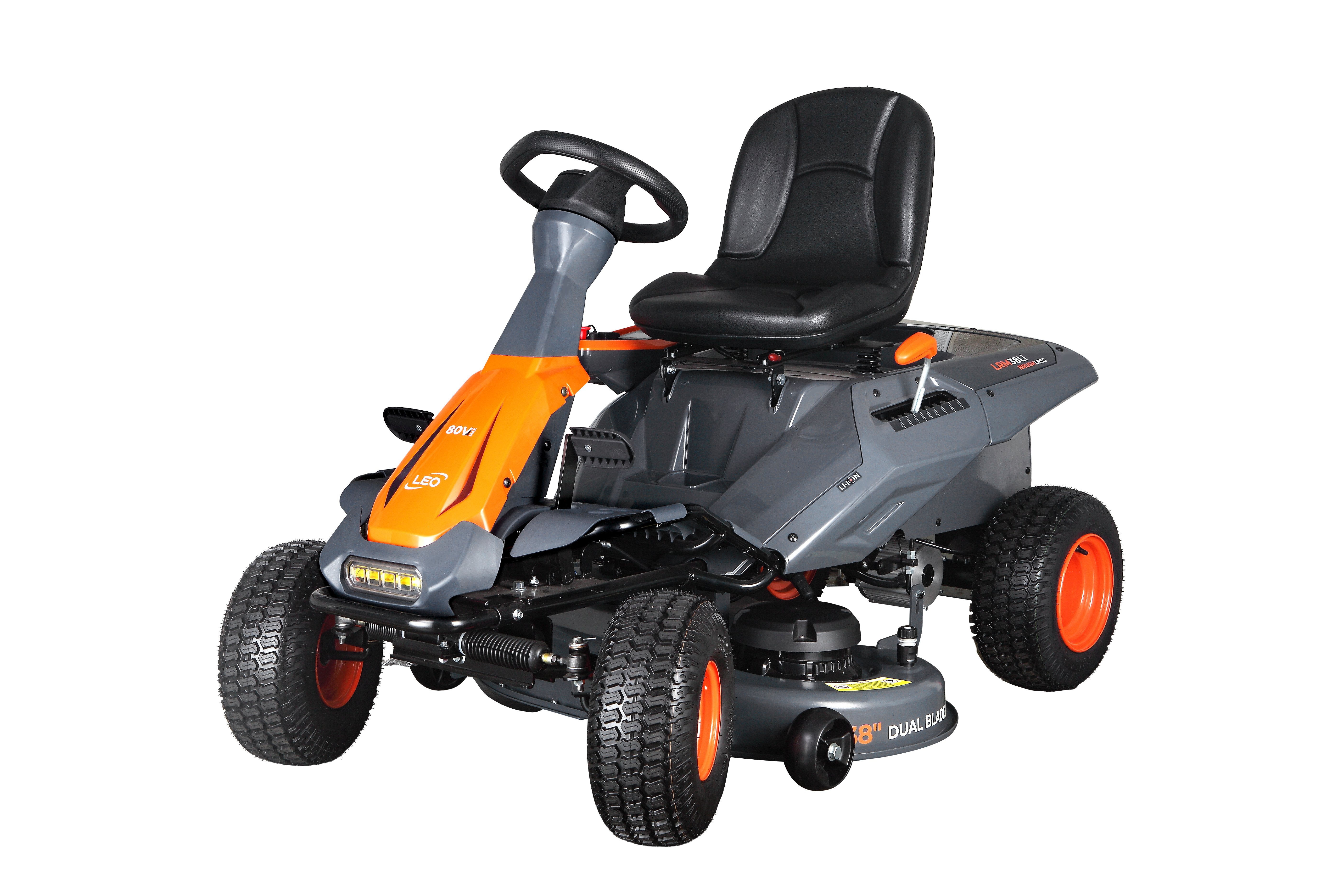 Battery-electric ride-on mowing can support planned maintenance routes where charging access and coverage are verified.
Comfort and control matter on larger maintained areas
A ride-on format is valuable because it reduces the walking and pushing burden of repeated mowing. Battery power does not change the need for a well-designed seat, sensible controls, visibility, a workable turning radius, and the right cutting width. It can, however, make the day feel less mechanically demanding by removing vibration and engine-management tasks associated with petrol equipment.
For gardens, courtyards, and light commercial grounds, a battery operated ride on mower is often most useful where lawns are open enough to benefit from seated mowing but complex enough that a compact turning circle and careful route planning still matter. The widest deck is not automatically the most productive choice. Narrow passages, trees, flower beds, gates, and trailer access can add more time than nominal cutting width saves.
What to verify before choosing one
A sound procurement decision is built around the actual site, not a generic battery claim. Use this checklist when comparing garden tools and electric machinery:
- Coverage: Can the battery operated ride on mower complete the intended route with a realistic reserve?
- Charging: Is there safe, weather-appropriate charging access at the depot or site, and is the turnaround time compatible with the route?
- Terrain: Does the manufacturer approve the model for the slopes, ground conditions, and towing or collection tasks involved?
- Cutting system: Are collection, mulching, and discharge options appropriate for grass length and the required finish?
- Service: Can the buyer obtain batteries, blades, wear parts, diagnostics, and trained support without excessive downtime?
- Safety documentation: Are applicable electrical, battery, and machinery documents available for the intended market?
That final point is especially important. Electrical equipment should be selected with verified documentation and a clear charging procedure, rather than on a promise of convenience alone. Battery integrity, charger compatibility, storage temperature, operator training, and isolation procedures all belong in the fleet plan.
When a battery ride-on mower may not be an appropriate fit
Battery power does not suit every operating context. Very large areas with no practical charging opportunity, heavy continuous cutting, severe slopes, remote work, or consistently dense and wet grass may require a different power strategy. A petrol machine can remain more practical in some of those situations. A practical approach may be a mixed fleet: use a battery operated ride on mower where quieter, lower-maintenance, repeatable work is valuable, and allocate other machinery to the jobs that exceed its validated operating envelope.
Conclusion
A battery operated ride on mower is suitable for modern landscaping because it aligns with quieter site operation, simplified routine maintenance, and planned commercial routes. Its value is strongest when teams treat it as part of a managed system of charging, service, safety, and route design. For property managers and contractors, the decision should come down to verified coverage and local support—not an assumption that electric machinery is automatically right for every lawn.
 Hot News