
 EN
How OEM Garden Machinery Helps Brands Expand Their Product Range?
For a garden-equipment brand, expanding the catalogue is not simply a matter of adding more SKUs. A new line has to make sense to dealers, end users, service teams, and the people responsible for inventory. OEM garden machinery gives brands a practical route to broaden their offer while keeping control of market positioning, packaging, and the features that matter to their customers.
From a B2B procurement perspective, the question is not only whether a factory can make a mower, tiller, shredder, or water pump. A more practical question is whether the proposed range can be specified, supported, and replenished as one integrated program. A capable manufacturing partner helps a brand move from a single product idea to a range that fits a defined customer and channel.
Why a broader range needs a product logic
Garden buyers often begin with one task, then discover adjacent needs. A homeowner may purchase mowing equipment first, then look for a shredder to manage pruning waste or a tiller for seasonal soil preparation. A landscaping customer may need a different mix of machines, spare parts, and service support. For a brand, these connected jobs create a reason to build categories around garden workflows rather than around isolated products.
The number that a buyer initially focuses on may be engine displacement or battery capacity. In practice, it is usually the match between the machine, terrain, workload, and expected maintenance that determines whether the product earns repeat demand. That is why OEM garden machinery planning should start with user segments and use cases, then translate those needs into a manageable assortment.
How OEM garden machinery supports range expansion
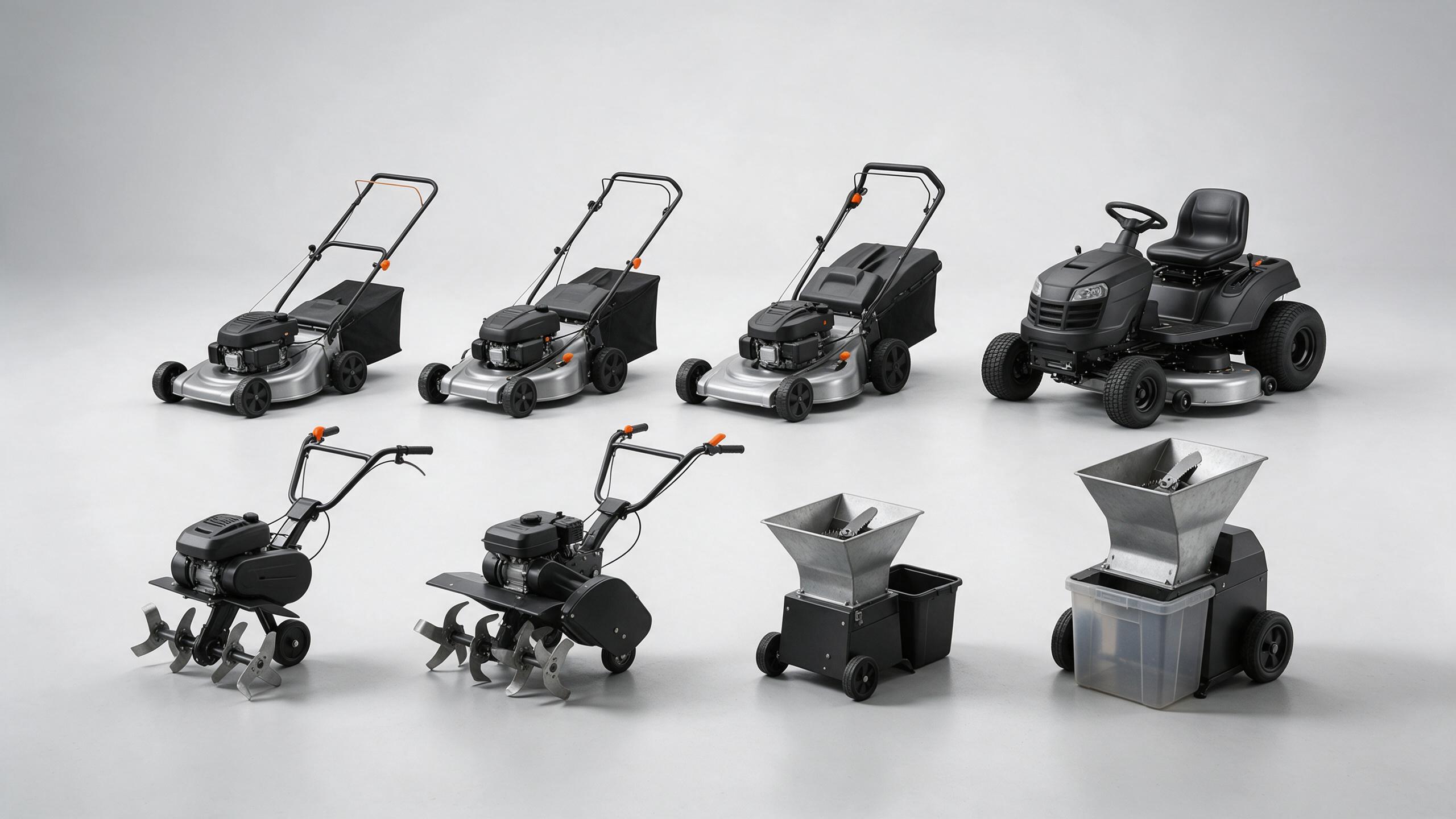
1. It lets brands enter adjacent categories at a measured pace
Working with an OEM enables a brand to evaluate a focused launch—such as walk-behind mowing equipment paired with garden-care tools—before committing to a large, disconnected catalogue. The initial range can be designed around a shared customer profile, price position, and dealer story. As demand becomes clearer, the program can extend to complementary categories without forcing the brand to build production capability for every product family.
For a long time, it can seem that one capable lawn mower should cover every garden task. Once a user adds equipment for debris handling or soil preparation, the workload may become easier to manage. That is useful for assortment planning: complementary tools should solve a distinct task, not merely duplicate an existing item.
2. Customization turns a factory platform into a brand offer
Customization is where an existing manufacturing platform can become relevant to a specific market. Depending on the product and the supplier’s confirmed capability, a brand may discuss visual identity, packaging, manuals, accessory selection, labels, and market-specific specification choices. The aim is not change for its own sake. Each decision should support a clear promise to the target customer and remain feasible for service, sourcing, and quality control.
Before requesting changes, prepare a brief that defines the target user, expected use conditions, channel, required documentation, and non-negotiable features. Ask the supplier to clarify which requests are standard options, which require engineering review, and which could affect minimum order quantities, lead time, or after-sales parts. This discipline helps keep customization from turning into a collection of costly exceptions.
3. Private label gives the range a consistent market identity
A private label program can help a retailer, distributor, or established equipment brand present related garden machines under one recognizable identity. Consistency reaches beyond a logo. It includes product naming, carton information, instructions, warranty process, replacement-part references, and the way dealers explain where each machine fits in the range.
Private-label work is strongest when the brand sets clear boundaries. Which products are entry, core, and specialist options? Which accessories are compatible? What information must be available to a dealer before a sale? A supplier can manufacture to the agreed brief, but the brand still owns the commercial architecture and must validate how the finished offer will be presented locally.
Choose a manufacturing partner for range continuity
A manufacturing partner should be assessed as part of the range strategy, not only as a source for the first purchase order. Ask how the supplier manages product documentation, packaging control, change communication, spare-part identification, quality checks, and repeat production. These details matter when a brand adds categories because inconsistency can create dealer confusion and extra service work.
For European sales, compliance planning should be part of the conversation early. The European Commission explains that CE marking is a manufacturer declaration that applicable legal requirements have been met for sale in the EEA. It also states that Machinery Regulation (EU) 2023/1230 applies on a mandatory basis from 20 January 2027. The applicability of rules varies by product and market, so brands should confirm their own responsibilities and required documentation with qualified compliance resources rather than assume that a mark alone resolves every obligation.
For brands serving Europe, a garden-machinery specialist with experience discussing packaging, documentation, and export requirements may help reduce handoffs. Still, verify the exact product scope, test evidence, and responsibilities for each planned model. Broad category experience is useful; it is not a substitute for product-level validation.
Build the supplier brief before selecting models
Give each potential supplier a structured brief so quotations can be compared on more than unit cost. A useful brief contains:
- Range role: the customer segment, task, and price position for every proposed product.
- Customization requirements: branding, packaging, manuals, labels, accessories, and any requested specification differences.
- Commercial assumptions: anticipated volumes, launch timing, markets, and forecast cadence.
- Quality and compliance questions: required documentation, inspection expectations, change-notification process, and market-specific checks.
- After-sales plan: spare-part references, warranty handling, technical information, and dealer training needs.
That brief makes it easier to compare OEM garden machinery proposals fairly. A lower quoted price can be less meaningful if packaging, documentation, parts support, or change control are undefined. Conversely, a proposal with a higher unit cost may fit the brand better if it reduces uncertainty in launch and service operations.
A practical rollout sequence
- Map the customer journey. Identify the garden tasks your current buyers cannot complete with the existing range.
- Choose two or three linked categories. Start with products that share a customer, channel, or seasonal story.
- Define the private-label system. Align product names, visual identity, cartons, manuals, and service references.
- Qualify the manufacturing partner. Review scope, communication, documentation, quality process, and after-sales readiness.
- Test the launch operationally. Confirm dealer information, parts records, packaging, and support before expanding again.
This approach does not require a brand to offer every garden tool at once. It provides a way to learn from the first category, protect the customer experience, and make the next addition more deliberate.
Questions to ask before adding OEM garden machinery
Before deciding between a petrol, cordless, or task-specific addition, ask one question: what problem does the new product solve for the buyer that the current range does not? The answer usually reveals whether the item has a real role or is only adding complexity.
- Does the product serve a defined garden size, terrain, or work pattern?
- Can the supplier confirm the permitted customization and associated commercial conditions?
- Will the private-label information remain consistent across product, packaging, manuals, and spare parts?
- What documentation and market checks are needed before launch?
- Can dealers explain the relationship between this item and the rest of the range?
Expand with control, not just breadth
OEM garden machinery can help a brand turn a narrow product offer into a more complete garden-care program. The value comes from deliberate category choices, usable customization, a consistent private label, and a manufacturing partner that can support repeatable operations. Begin with the buyer’s task, document the requirements, and add products only when they strengthen the range as a whole. That makes expansion easier for the brand to manage and clearer for customers to understand.

 Hot News