
 EN
EN
Safe Operation Guidelines for Petrol Lawn Mowers in Daily Garden Maintenance
As a garden machinery specialist with hands-on experience evaluating petrol lawn mowers across a wide range of terrain types, the most common question I encounter is not which model to buy — it is how to operate it safely once it arrives. A petrol lawn mower is one of the most capable tools in any garden maintenance toolkit, but it demands respect and a consistent pre-operation routine. Preventable accidents remain a real risk without it.
The number I kept checking when first evaluating petrol mowers was engine displacement. It was only after actually running one on a sloped rear garden that I understood that technique, preparation, and safety awareness matter far more than raw engine size when things go wrong.
Why Safe Operation Matters
Lawn mower accidents are more common than most garden owners realise. According to data from the American Academy of Pediatrics, more than 5,000 children receive emergency treatment each year for power mower-related injuries. The majority of these incidents are preventable with proper procedures. For anyone using a petrol lawn mower as part of a regular garden maintenance routine, understanding and consistently applying an operation guide is not optional; it forms the baseline for responsible use.
The most frequent causes of injury are not mechanical failure. They are procedural: failure to check the work area, improper slope technique, refuelling while the engine is still warm, and operating without appropriate protective equipment. Each of these is fully within the operator's control.
Pre-Operation Inspection Checklist
Before starting a petrol lawn mower, carry out a structured pre-operation check. This takes no more than five minutes and significantly reduces the risk of mechanical and operational failures during a mowing session.
- Fuel level: Check the fuel level and refuel if necessary — but only when the engine is cold and the mower is parked in a well-ventilated outdoor area.
- Oil level: Check the engine oil using the dipstick. Running a petrol mower with insufficient oil causes rapid engine wear and potential seizure.
- Blade condition: Inspect the blade for cracks, bends, or significant dulling. A damaged or unbalanced blade creates vibration and increases throw risk.
- Safety guards and deflectors: Confirm all guards, shields, and the grass discharge deflector or catcher are securely fitted.
- Spark plug connection: Verify the spark plug is properly connected. Any blade height adjustments or debris removal must be done with the spark plug disconnected and the engine off.
- Work area clearance: Walk the entire mowing area before starting. Remove stones, sticks, wire, toys, and any other objects that could be picked up by the blade and thrown at speed.

Protective Equipment for Petrol Mower Operation
Mower safety begins with the operator, not the machine. The following protective gear should be worn during every mowing session. Adjusting the specific equipment based on garden conditions is reasonable, but omitting it entirely is not.
- Eye protection: Safety glasses or goggles are essential. Petrol lawn mower blades operate at high rotational speeds and can project debris across a wide radius.
- Hearing protection: Petrol engines generate significant noise over extended periods. Earplugs or ear defenders reduce cumulative hearing exposure during regular garden maintenance sessions.
- Sturdy footwear: Closed-toe, non-slip shoes or boots are required. Sandals and lightweight trainers offer inadequate protection around rotating blade equipment.
- Close-fitting clothing: Loose clothing increases the risk of entanglement. Avoid scarves, drawstrings, or untucked garments when operating any powered garden machinery.
Safe Mowing Techniques
Proper technique during operation reduces both accident risk and mechanical wear. Mow only in adequate daylight and avoid operating immediately after rain — wet grass clogs the discharge path, adds weight to the grass catcher, and reduces blade efficiency.
If your garden is under a quarter of an acre and relatively flat, a standard walk-behind petrol mower will handle it without issue. But if you are regularly cutting steep sections, technique becomes the most important variable in your mowing routine.
For walk-behind petrol lawn mowers on slopes, mow across the face of the slope, not up and down. Moving vertically on a slope increases the risk of the operator slipping and sliding underneath the mower. On gentler inclines, maintain deliberate footing before each pass. Avoid mowing slopes that are excessively steep or wet.
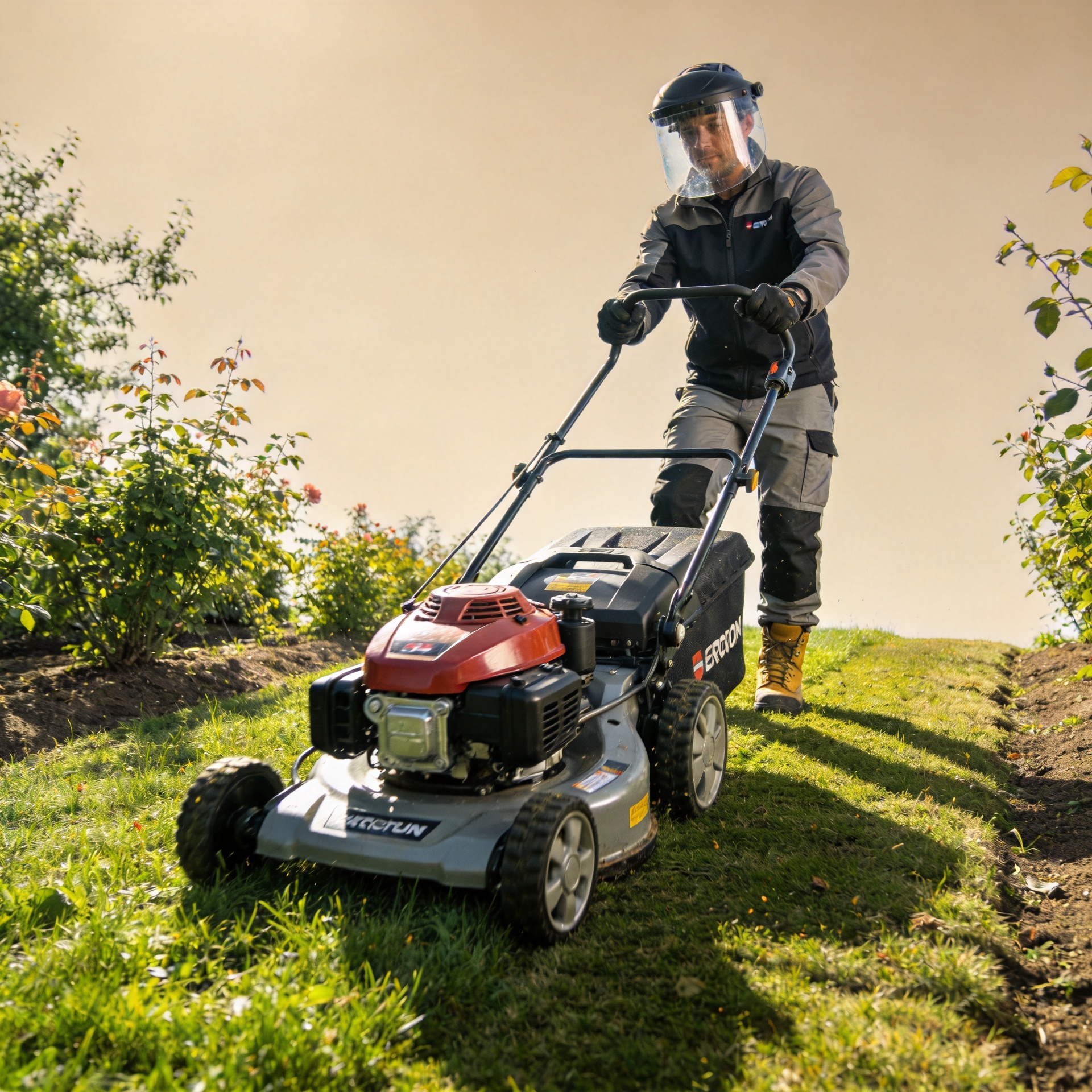
When approaching obstacles such as trees, flowerbeds, or corners, slow the mower's forward speed and increase awareness of your surroundings. Do not pull a walk-behind petrol mower backwards over a slope or uneven ground while the blade is engaged; disengage the blade first.
Fuelling and Post-Operation Procedures
Fuel handling is where petrol mower users most commonly cut corners, and it carries the highest fire risk of any routine maintenance task. Turn off the engine and allow it to cool completely before refuelling — ideally for at least ten minutes. Do not smoke and do not use open flames near the mower during or after refuelling.
Store petrol in approved containers, away from heat sources and direct sunlight. If you store your petrol lawn mower in a garage or shed, do not refuel it indoors. Take the mower outside, allow the engine to cool, then refuel in a ventilated area.
After a mowing session, before walking away from the machine, stop the engine and wait for the blade to come to a complete stop. Do not reach under the mower deck for any reason until the blade has fully stopped and the engine is off. If clearing a blocked discharge chute is necessary, disconnect the spark plug lead first.
Keeping Children and Pets Safe During Garden Maintenance
Children and pets are naturally drawn toward garden machinery in operation. Establish a clear exclusion zone around the mowing area before starting. Children should be indoors or at a confirmed safe distance — visual proximity is not sufficient when operating a petrol lawn mower near them.
My default assumption was that keeping children nearby was manageable with supervision. That held true until a neighbour's young child ran toward the mower during a garden maintenance session, when the reality of response time versus blade stop time became very clear. Distance is the only reliable safety measure.
Reading and Following Your User Manual
The operation guide and user manual supplied with a petrol lawn mower are not supplementary reading — they are the primary technical reference for that specific model. Engine type, blade engagement mechanism, self-propulsion system, and safety kill switch operation can all vary significantly between models. Review the user manual before first use and keep it accessible for reference during routine maintenance intervals.
Pay particular attention to the manufacturer's recommended maintenance schedule: air filter cleaning, blade sharpening intervals, oil change frequency, and spark plug inspection. A well-maintained petrol lawn mower is a safer one, and manufacturer guidance provides the baseline for that schedule.
Summary
Operating a petrol lawn mower safely in daily garden maintenance comes down to consistent habits: pre-operation inspection, appropriate protective equipment, correct mowing technique, controlled fuel handling, and maintaining a safe distance for others. These are not occasional precautions. They are the standard operating procedure for every single session. Following them extends the working life of the machine and, more importantly, protects everyone in the garden.


 Hot News