
 EN
How Garden Machinery Manufacturers Ensure Product Quality Before Export?
For an importer, the real question is not whether a sample looks acceptable on arrival. It is whether the production batch will match the approved configuration, documentation, and packing requirements when it reaches the destination port. A capable garden machinery manufacturer builds that confidence through a repeatable quality-control process rather than a final, hurried inspection. This matters for lawn mowers, tillers, shredders, ride-on machines, and water pumps alike, because one inconsistency can trigger warranty work, delayed launches, or difficult conversations with distributors.
When sourcing at scale, price per unit is only one part of the decision. Factory production discipline, traceability, and the ability to prepare export documents are just as important. The checklist below shows what buyers should expect before a garden machinery shipment is released.
Start With a Clear Quality Plan Before Factory Production
Quality control begins before parts reach the assembly line. A garden machinery manufacturer should translate the approved sample, purchase order, drawings, labeling rules, and target-market requirements into a production quality plan. This plan identifies the model version, critical components, inspection points, acceptance criteria, and records to retain.
That early alignment is especially valuable in OEM work. A change that seems minor—such as a different switch, blade, engine variant, carton marking, or instruction manual—can change what inspectors need to verify. The practical goal is simple: every department should be working to the same approved version. A buyer can ask for a pre-production checklist that lists the final product code, packaging artwork revision, and required test records.
In markets where CE marking applies, the mark is a manufacturer declaration that applicable requirements have been addressed; it is not a general quality label. For relevant equipment, the technical documentation and the delivered configuration must remain aligned. That is why export standards should be considered at planning time, not after containers have been booked.
Inspect Incoming Materials and Critical Components
The first physical control point is incoming inspection. Instead of assuming purchased parts are consistent, the factory checks components that affect safety, function, or appearance against the approved specification. Depending on the machine, these may include engines or motors, batteries, cutting blades, fasteners, guards, wheels, cables, switches, fuel-system parts, and molded housings.
A useful quality control record identifies the lot, supplier, quantity checked, inspection result, and disposition of nonconforming material. This makes it easier to isolate a component lot if a problem appears later. It also stops unsuitable parts from being mixed into normal factory production.
Buyers do not need to prescribe every sampling method. They should, however, ask which components are treated as critical and how the factory separates accepted, pending, and rejected material. A clear answer is more informative than a generic statement that all parts are checked.
Control the Assembly Process, Not Just the Finished Unit
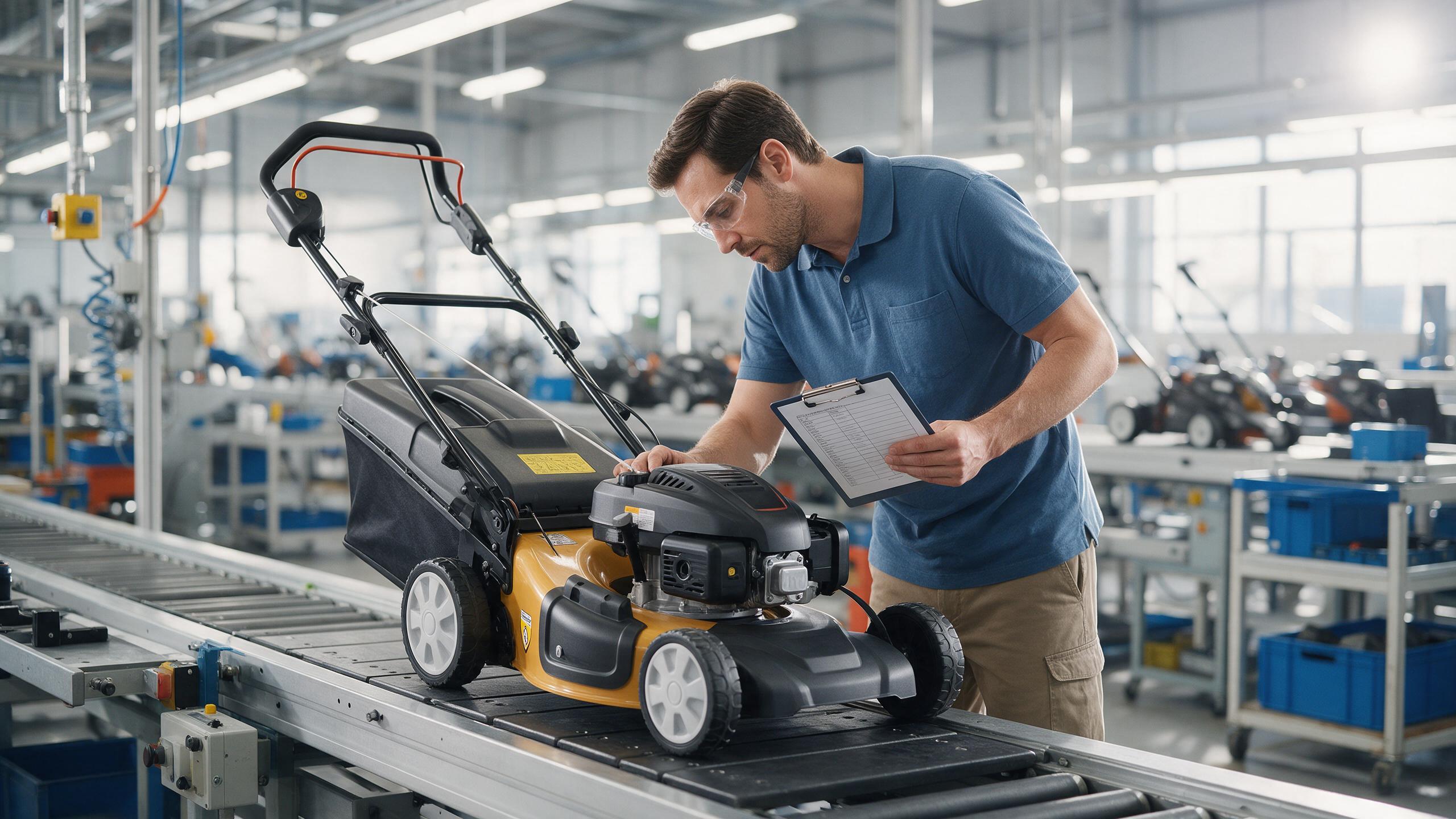
Final inspection alone cannot reliably reveal every assembly error. Strong factory production uses in-process checks at the stations where mistakes are most likely to occur. For a mower or tiller, this may include torque confirmation for safety-related fasteners, routing and retention of cables, guard installation, fluid or fuel-system checks where relevant, and verification that the correct model-specific parts were fitted.
Work instructions should show operators the approved sequence and the inspection points that require a sign-off. Supervisors can then respond while a deviation is still limited to one station or one production lot. From an engineering standpoint, this is what connects consistency to scale: the process must make the correct build easier to repeat than an improvised one.
It is tempting to focus on engine size or a headline specification. In export work, configuration control often tells a buyer more about dependable delivery. If the factory cannot show how it prevents parts from one variant entering another, the sample may not represent the shipped batch.
Use Functional Tests That Match the Machine
Each garden machine needs a functional release check suited to its design. A garden machinery manufacturer may verify starting, controls, cutting or drive engagement, safety interlocks, abnormal noise or vibration, leakage, and visual finish as appropriate to the model. The point is not to claim that every unit receives the same test; it is to establish a documented test method that reflects the product’s real operating risks.
For equipment intended for markets with outdoor-noise rules, the applicable requirements should be confirmed for the product category and destination. Directive 2000/14/EC regulates environmental noise emissions from certain outdoor equipment, but applicability and the correct conformity route depend on the machine. Buyers should ask the supplier to identify the requirement that applies to the ordered model rather than rely on a broad claim about export standards.
Test results should be traceable to the model and production lot. That traceability helps a distributor understand whether a shipment issue is isolated or potentially repeated across a batch. It also gives the factory a factual starting point for root-cause analysis if a field issue is reported.
Audit the Batch Before Shipment
Before export, quality control normally includes a finished-product inspection based on an agreed sampling plan. Inspectors compare units with the approved order and check appearance, assembly, operation, accessories, labeling, manuals, and carton information. The release decision should also cover count accuracy and whether any rework has been closed and re-inspected.
This is where an OEM buyer should look beyond a pass/fail statement. Request a report that states the inspection date, model, quantity presented, quantity inspected, findings, corrective actions, and final disposition. If defects were found, ask whether the lot was re-screened after correction. A report with that context is more useful for supply planning than a photograph of a few finished machines.
Verify Packaging, Labels, and Export Documents
A machine can pass functional inspection and still arrive with a preventable export problem. Packaging checks should confirm the right carton, marks, protective materials, accessory count, barcode or label version, and manual language for the destination. For seasonal garden equipment, a labeling or packing error can disrupt a distributor’s launch even when the product itself works correctly.
Document control should be part of the shipment-release gate. Depending on the destination and product, the buyer may need instructions, declarations, test records, packing lists, invoice details, and other compliance materials. The manufacturer should verify that document references match the product version and labels in the cartons. This is a practical way to keep export standards connected to the physical goods.
What Buyers Should Ask Before Approving an Order
- What is the approved reference for the production version: sample, drawing, bill of materials, or specification sheet?
- Which incoming components are treated as critical, and how are lots identified?
- Which in-process checks are recorded during factory production?
- What functional tests apply to this model, and what constitutes a failed result?
- How does the factory control rework and re-inspection before shipment?
- Which destination-specific export standards and documents are relevant to the ordered configuration?
- Can the supplier provide a pre-shipment quality control report linked to the order and production lot?
Quality Is a Release System, Not a Last-Minute Claim
The strongest suppliers make quality visible in their process: approved specifications, incoming checks, controlled assembly, relevant functional testing, batch inspection, and document verification all lead to one shipment decision. A garden machinery manufacturer that can explain this chain clearly gives importers a more practical basis for supplier qualification and OEM planning.
For buyers, the next step is to turn these questions into the purchase-order checklist. Ask for the evidence before production begins, review it again before shipment, and make sure the agreed quality control records follow the same product version that will enter your market.
 Hot News